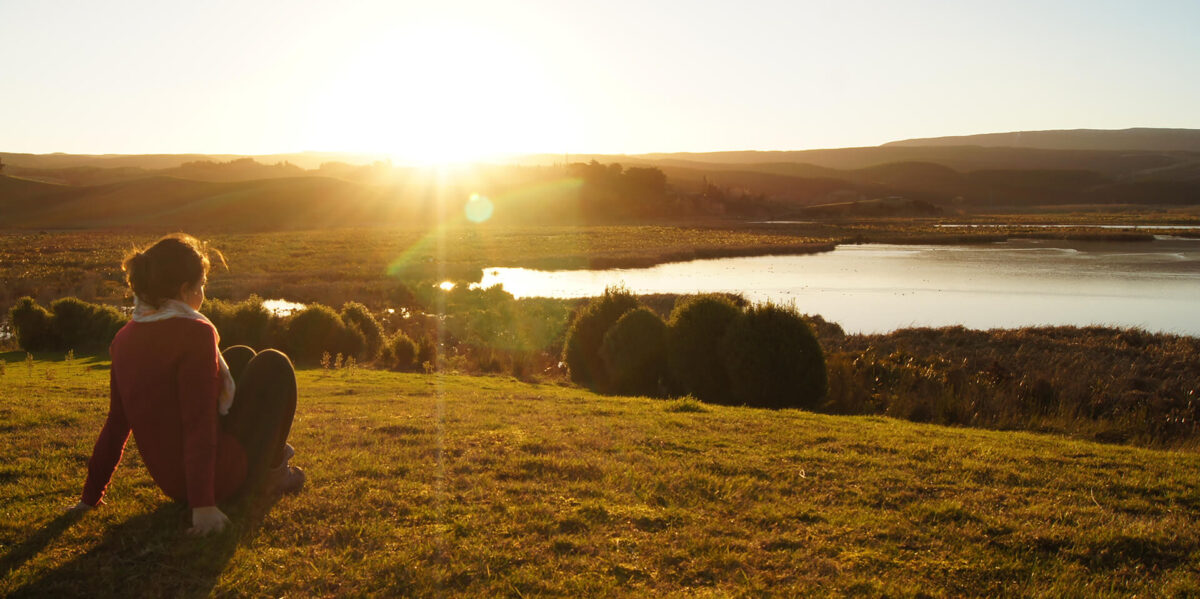
Image credit: Te Nohoaka o Tukiauau / Sinclair Wetlands Trust
Wetlands are found where the water table is at or near the surface of the land, or where land is permanently or temporarily (as with the tides) covered by water. Wetlands are areas where water is the primary factor controlling the environment, plant and animal life. They can be either freshwater, estuarine (brackish, by the sea) or both. Although once thought of as mosquito-filled swamps or bogs, and often drained and built on, we now know that wetlands are pure climate gold!
Again, they’re the ‘kidneys of the earth’, cleaning the water that flows into them. They trap sediment and soils, filter out nutrients and remove contaminants; they can reduce flooding and protect coastal land from storm surge. They are vital for maintaining water tables and they return nitrogen to the atmosphere. We now understand their essential purpose and that they are one of the world’s most productive environments. In New Zealand wetlands support the greatest concentration of wildlife out of any other habitat, but they’re very much under threat!
At The Gift Trust we’re delighted to support a number of organisations restoring and caring for wetlands.
Pae tū Mōkai o Tauira
This Hapori Māori group is one of many working for the restoration and conservation of Wairarapa Moana, in South Wairarapa. A donor from The Gift Trust supported this organisation by making two generous gifts over the past year.
Wairarapa Moana is home to at-risk species of plants such as carex cirrhosa and carex bruchananii that are only found in a few other locations around the country. Supporting the ongoing cultivation of these plants is key to maintaining the ecosystems of wetlands not just in Wairarapa but across Aotearoa.
The team eco-sources seed from the moana and surrounding areas, then propagates at their native nursery, He Kōtare. The new plants are then sold for the purposes of riparian planting, wetland expansion or to enhance biodiversity. They sell to Greater Wellington Regional Council, local council, water catchment groups, private landowners and gardeners. He Kōtare has been in production for two growing seasons and they expect to grow around 70,000 plants this year. A donor from The Gift Trust supported this project by making a generous gift last year.
The focus for the future at Pae tū Mōkai o Tauira is the growth of He Kōtare Native Plant Nursery and the continued restoration and protection of Wairarapa Moana. The work this group does within its community gives them the opportunity to give expression to their Kaupapa Māori values of kaitiakitanga, manaakitanga and rangatiratanga.
Te Nohoaka o Tukiauau / Sinclair Wetlands Trust
Te Nohoaka o Tukiauau/Sinclair Wetlands form a 315 hectare portion of the Lakes Waihola-Waipori wetland complex, south of Dunedin. The name Te Nohoaka o Tukiauau acknowledges ‘the dwelling place of Tukiauau’, an early Ngāti Mamoe chief. One of our donors at The Gift Trust supported this organisation last year with a gift that helped them cover their day to day costs.
The area is now owned by Te Rūnanga o Ngāi Tahu, and is valued as a wāhi taonga (culturally significant site), for mahinga kai (traditional food and resources), conservation, recreation, and education.
The wetlands are part of a nationally important and regionally significant wetland complex in the Taieri Plains. There is a mixture of river channels, pools, swamps, and forested islands. Waterbirds are abundant, and are a focus for visitors, who are welcome to walk or kayak, to stay overnight, to help as volunteers, and to connect to the wetland environment, via education and hands-on participation.
Management of the wetlands includes enhancing wetland habitats, control of weeds and pests, and replanting native forest on the ‘islands’ within the wetlands. These activities are looked after by an on-site coordinator, on behalf of Te Nohoaka o Tukiauau. The team aims to enhance appreciation of and opportunities for sustainable food gathering, to increase cultural awareness, and reconnect people back to the land, through education and hands-on experience.
During the pandemic, the Ministry for the Environment joined forces with the Sustainable Business Network to fund a project called Jobs for Nature. This propped up a number of environment organisations around the country for the three crucial pandemic years with funds to hire people on project work. This funding has now come to an end which has left a number of organisations, including Te Nohoaka o Tukiauau, reassessing their ongoing priorities.
It was here that The Gift Trust was able to help. One of our donors asked about climate change efforts in the lower South Island and we spoke to the team at Te Nohoaka o Tukiauau about their funding gaps. They were suffering from the sadly common story of some funders not being able to cover overheads. They were struggling to pay rangatahi from their local marae to maintain the walking tracks. Our donor helped out with the funding needed to keep the tracks and lawns around the wetland pristine and provide the young people with an income.
Boom Rock Farm Restoration
“In the Wellington region only 2.3% of the original extent of wetlands remain, and only 16% of forests. Ohariu Valley was virtually stripped of native forest in the early 1900’s, and many of the wetlands drained to create more farmland. 100 years on, what should we do with our little Ohariu farm if we’re not farmers?”
This project is held within The Gift Trust’s Gift Collective fundholding platform and we’ve enjoyed watching it start to grow. Literally. This is the journey of a well known Wellington icon, Boom Rock Farm, being taken back in time to “set things right”. The Boom Rock folk are getting in, gumboots and all, to restore their land to its former state.
“We want to restore our little piece of New Zealand to its natural state – including returning the land from pasture to plants, and preserving our wetlands and waterway. We don’t use the farm for grazing, so let’s get rid of the pasture and replace it with a forest. We don’t need to put stock in the wetlands, so let’s protect it so it can regenerate.”
In partnership with the Greater Wellington Regional Council the team plan to ring-fence the wetlands – allowing the plants to regenerate, wildlife and birdlife to return, and to protect the stream at the bottom of the farm. In the background they’ve already started a planting programme, and will continue to add more native wetland, coastal and bird-friendly species – with every plant needing protection from rabbits and the wind.
They’re working hard to find cost effective ways to make their vision a reality – using salvaged materials, growing their own plants or sourcing them for free or in bulk, using in-house and volunteer labour.
“We love that the benefits from planting and wetland ring-fencing will ripple out beyond our little farm – encouraging others in our rural community to return less productive farmland to forest, extending the outer Green Belt to provide shelter and food for native species, improving water quality by filtering wetland runoff, returning the landscape to its natural character, getting people together and sharing knowledge and resources.”
Native Forest Restoration Trust
The Native Forest Restoration Trust (NFRT) is dedicated to protecting New Zealand’s native forests and wetlands. Not just for today, but for generations to come. We were delighted when one of our donors sent a gift their way.
The Trust was formed in 1980 when a group of people got together to protest the felling of giant totara in Pureora Forest. Their ethos remains the same as it was back then – if we all come together, we can achieve extraordinary things. And they have achieved extraordinary things. Today, the Trust manages over 8,000 hectares of reserves, protected forever for all New Zealanders to enjoy.
“In New Zealand, wetlands support the greatest concentration of wildlife of any of our habitats. They also purify water, prevent floods and erosion, store carbon, provide resources like peat and flax, process nutrients, act as nurseries and offer recreation and aesthetic value.
Around 90% of our wetlands have been destroyed since 1850. Even today, our wetlands face drainage, clearance, pollution, choking sediment and invasive weeds. Less than 250,000 hectares of our original wetlands now remain.
Throughout New Zealand’s more recent history our lowlands have been extensively impacted by land clearance and logging, and through the effects of non-native species introduced by settlers. This has led to fragmentation of our indigenous lowland, wetland and coastal habitats and a bias toward alpine and upland habitats in our public conservation land.
By the late 1800s, some people were starting to realise the consequences of these changes to New Zealand’s biota, but it wasn’t until the 20th century that steps began to be taken to protect land with the primary aim of conservation of wildlife and habitats.
NFRT aims to restore damaged forests and wetland habitats and, where possible, increase the size of the habitat. We do this by active conservation management to control pests, encourage native tree seedling establishment and plant native trees where appropriate. We often purchase marginal farmland which includes remnants of existing natural habitat of biodiversity value; or rough pasture adjacent to existing valuable natural habitat.
The new reserve is then protected with a QEII National Trust covenant, and where possible we create public access and interpretation for visitors’ enjoyment and appreciation.
As well as protecting native wildlife, the process of securing, managing and restoring forests and wetlands creates an active carbon sink, contributing to the nation’s efforts to create resilience towards climate change.”
