Recently, Jill Ford, whose Gift Account, the Feminista Fund, is held at The Gift Trust, travelled through Sri Lanka, East and Southern Africa, and Madagascar. There she witnessed firsthand the profound disconnect between the statistics we debate and the lived reality of billions. This is Jill’s story, in her own words.
What I Witnessed
Children walking kilometers with no shoes to reach schools that may or may not have teachers.
Families making impossible choices—send a child to school, or have the children make bricks, carry water, or work the fields. When parents can’t afford pens or uniforms, education becomes a luxury.
Homes without toilets, water or electricity.
Clothes must be washed in local rivers/ lakes where drinking water is often also collected.
Many young teenage girls carrying babies / toddlers – a result of lack of contraception and / or sexual health information
But what moved me most were the women and girls—and the local organisations fighting for them.
The Reality for Women and Girls
Tanzania: The Maasai Girls Rescue Centre
Despite FGM being illegal in Tanzania and Kenya, it continues. Once girls are cut and start menstruating, they are considered available to be sold into marriage for livestock. Girls as young as 10 are sold to men 60 years or older, the men invariably have several wives. But when they die the widows have no inheritance rights and cannot remarry.
The Maasai Girls Rescue Centre provides sanctuary—hostel facilities, skills training, an eco-garden, and an eco-lodge generating income. Girls are bused to school behind high walls so they cannot be abducted.
Uganda: Three Women-Led Projects
There are many women’s groups in Uganda, but very little funding or tangible support for them.
In Uganda, I visited three small, community-based, women-led projects I already supported. A common challenge across all three: lack of sexual health information and access to contraceptives, resulting in high teen pregnancy rates, child marriage, domestic violence, and inheritance customs where boys inherit family land.
1. SHARE (Strengthening Hope and Resilience Empowerment)
SHARE prepares young adults for self-employment, entrepreneurship, employability, and making less risky health decisions. They work with school-going and out-of-school girls and boys who are at risk and victims of child marriage or teenage pregnancy, helping them achieve self-reliance through a holistic approach.
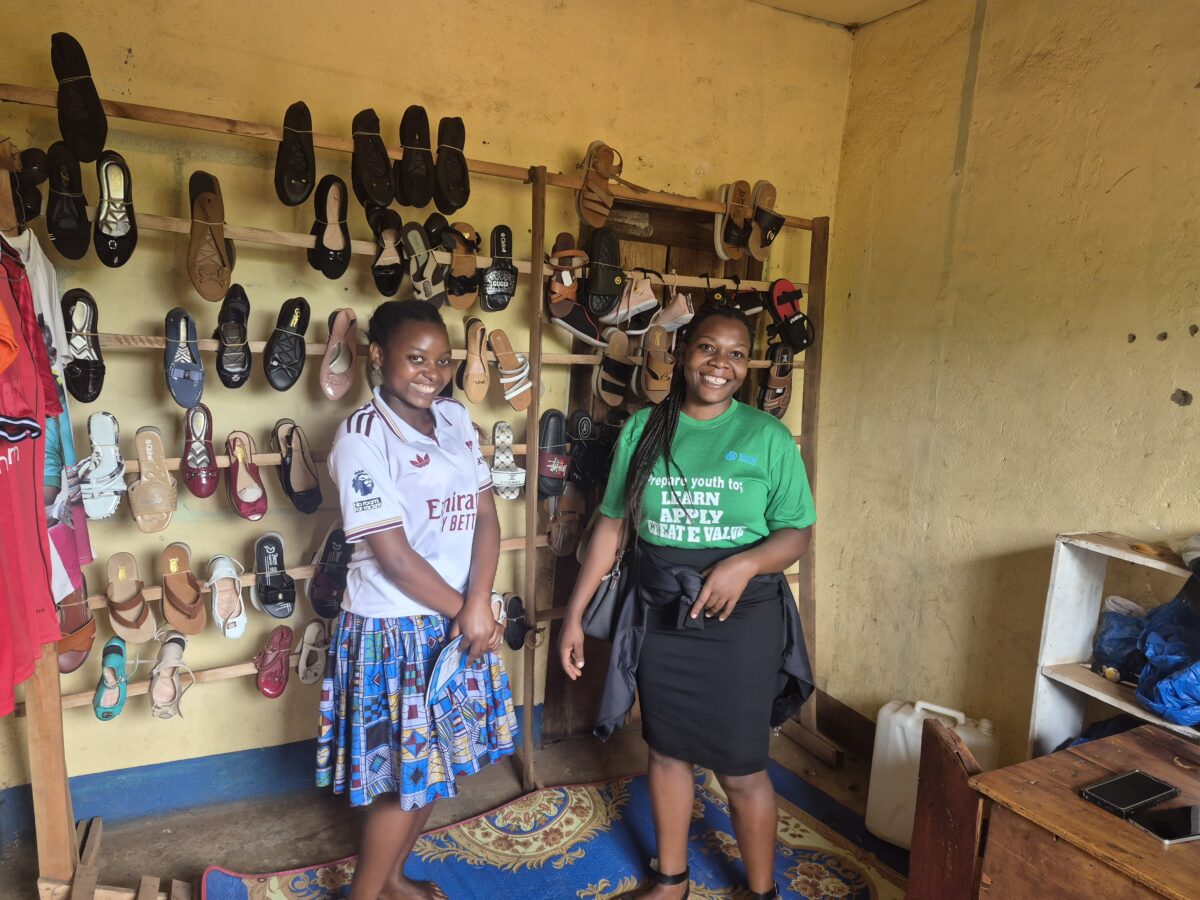
We met with Sengoma, the founder, and three board members on the outskirts of Kampala, then travelled to rural areas to meet girls and boys in SHARE programmes. We met girls who had set up small businesses in their villages. Their biggest barriers? Lack of capital to grow and fierce competition in their local markets.
2. Gufasha Girls Foundation
Founded by Joan Kembabazi in 2016, Gufasha Girls Foundation advocates against child marriage and promotes girls’ education.
Joan’s story is deeply personal. Her childhood best friend, Maureen, was married off at 13, forced to quit school, experienced a difficult marriage, and died during childbirth. Joan founded Gufasha in her memory.
We visited for the launch of their Adolescent and Youth-Friendly Health Corner in rural town of Bbaale, – a two-hour bumpy drive from Jinja (source of the Nile). Set in a marquee alongside the medical centre, with support from a female doctor and nurse, it is more than a physical space. It is a place of trust, hope, and opportunity.
Here, adolescents can ask questions without fear, access reliable sexual and reproductive health information, and receive youth-friendly services free from judgment. When young people have safe spaces to learn, they gain the power to lead and make informed choices.
3. Mughende Women Farmers Association (MUWOFA)
MUWOFA was founded in 1997 by 30 women with a mission to fight poverty in the Rwenzori region (near the Queen Elizabeth NP) through savings and credit, sustainable agriculture, and domestic violence prevention.
What struck me was the breadth of their work. They provide training in beekeeping, carpentry, welding, and accounting—everything the modern farmer needs. Their savings and credit programmes relieve poverty. Their community work fights domestic violence.
The grounds feature a wide range of crops, an irrigation system, a new greenhouse, and a drying room. With our funds, they are installing a solar system to power irrigation and a refrigeration unit so crops have longer life. This has enabled women to farm more productively and increase their incomes—some have bought their own land.
The Legacy of Colonialism
Every country I visited had been colonised. The colonial agenda was extraction—cheap labour, minerals, ivory, timber. Little was invested in education, manufacturing, or infrastructure. Colonial administrators often empowered ethnic minorities to “assist” with governance, sowing divisions, exploitation by multinationals (and countries) and corruption that persists today.
This is not an excuse—it is context. Understanding history is essential to designing solutions that work.
How You Can Help
The organisations I visited are led by local women who understand their communities. They are not waiting for outside solutions—they are building them. But they need **capital, resources, and sustained support**.
WHAT YOUR GIVING CAN DO
Fund Girls’ Education and Safety
Support rescue centres, safe houses, and scholarship programmes that keep girls in school and protect them from FGM and child marriage. Gufasha Girls Foundation, Maasai Girls Rescue Centre
Invest in Women’s Economic Empowerment
Provide capital for small businesses, savings programmes, and skills training. When women earn, they transform their families and communities. SHARE, Mughende Women Farmers Association
Champion Sexual and Reproductive Health
Fund youth-friendly health centres that provide information and services without stigma or judgment. – Gufasha Girls Foundation, SHARE
Support Community-Led Solutions
Back organisations founded and run by local women. They know the challenges—and the solutions. Mughende Women Farmers Association
Take Risks on Small, Grassroots Initiatives
Many effective organisations are too small for major funders. Your flexible giving can fill this gap.
The Gift Trust Advantage
As Gift Trust donors, we have the resources, networks, and flexibility to support organisations that larger funders overlook. We can take risks on small, grassroots initiatives with transformative potential.
The organisations I visited achieve remarkable results with very little. Imagine what they could do with more.
All of these charities are now registered with The Gift Trust so you can easily donate directly to them or find out more on their websites.
